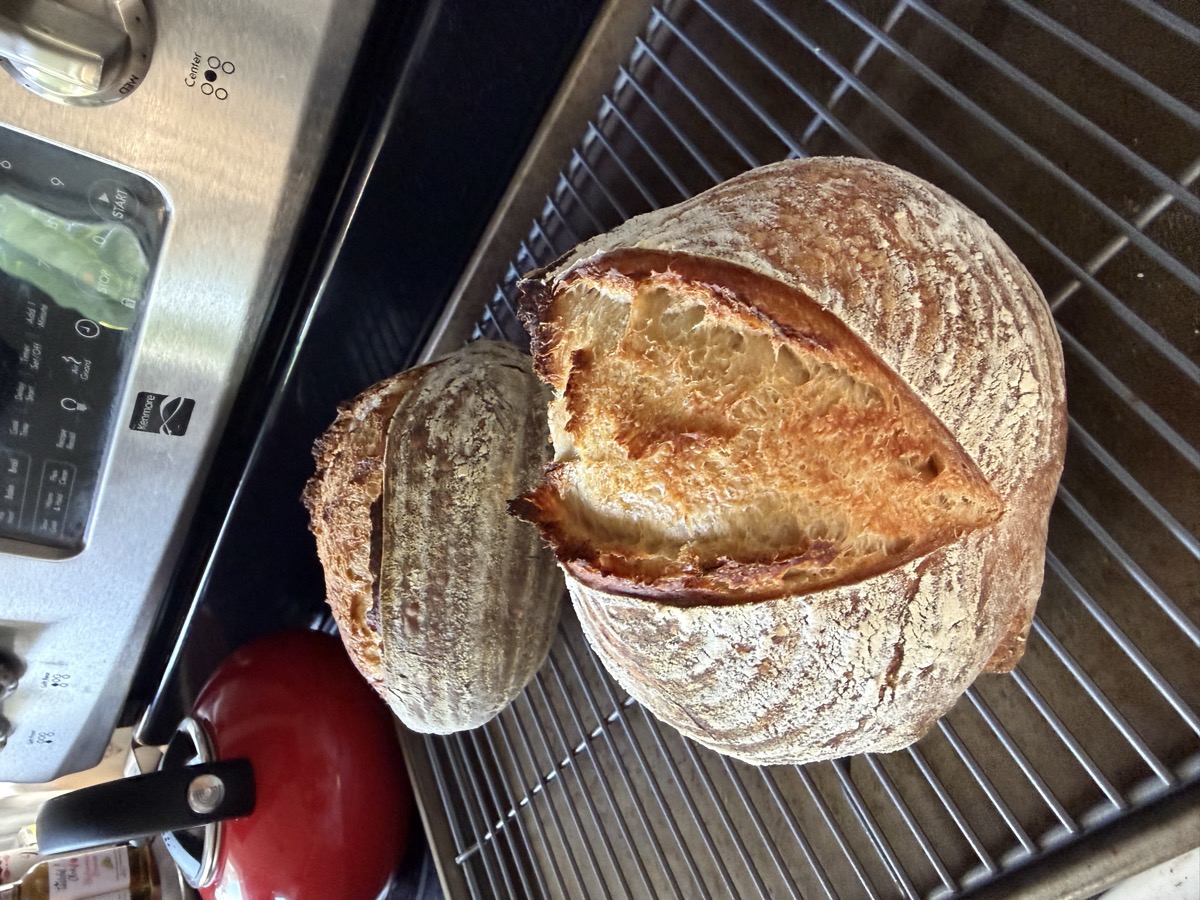
🍽️ Baking
⏱ 3-4 days
👥 2
Instructions
1
To prepare your starter: Remove starter from the fridge. Feed it with 55 grams flour and 55 grams water. Leave at room temperature until it doubles in volume.
2
If the starter doubles within 6 hours, it is ready to use. If not, discard all but 20 grams of starter, then re-feed with 55 grams flour and 55 grams water.
3
Use the starter just after its peak: the dome has flattened slightly, it smells tangy/yogurty (not sweet), and bubbles are visible (not collapsing).
4
Autolyse: In a bowl, mix 375 g flour and 255 g water until no dry flour remains. Cover and rest for 30 minutes.
5
Add Starter & Salt: Add 105 g active starter and 9 g salt to the dough. Mix by pinching and folding until combined. The dough will feel sticky.
6
Stretch & Folds: Over 2 hours, perform 4 rounds of stretch and folds, one round every 30 minutes. For each round, with wet hands, stretch one side of the dough up, fold it over, rotate the bowl, and repeat 4 times.
7
Bulk Fermentation: After the last fold, let the dough rest at 73-75°F until its volume increases by 50-75%, it is jiggly, and a poke springs back slowly. This usually takes 3.5-5 hours.
8
Pre-shape: Lightly flour a counter. Gently turn the dough out and shape it into a loose round. Rest for 15-20 minutes.
9
Final Shape: Shape the dough into a tight round or oval, creating surface tension without tearing. Place the dough seam-side up into a floured bowl or banneton.
10
Cold Proof: Cover the dough and refrigerate for 18-24 hours. Bake straight from the fridge.
11
Baking: Preheat the oven and a Dutch oven to 475°F for at least 30-45 minutes.
12
Bake covered at 475°F for 20 minutes.
13
Uncover and bake at 425-435°F for 15-18 minutes.
14
Cooling: Cool the bread on a wire rack for 1 full hour before slicing.
Notes
This recipe is designed for baking once per week, yielding 1 small loaf (perfect for 2 people) with a clear sourdough tang and a softer crust. It's tuned for a 73-75°F home. Use bread flour or all-purpose flour. Hydration is ~70%. The timing of using the starter just after its peak is a major driver of sour flavor. Do not chase doubling during bulk fermentation; trust dough signs. For a softer crust, you can optionally brush lightly with butter or olive oil, or cool the bread under a towel. For storage, keep at room temp for 3-4 days (cut side down, loosely covered) or slice and freeze for 2-3 months (toast from frozen). For more tang, use a longer cold proof or slightly less starter. For more complexity, add 10-15% whole wheat or rye flour. Trust dough signs over the clock. Slightly early shaping is better than late. The fridge does the flavor work.